
 Image 1 of 1
Armenian Duduk
A Deeply Soulful Wind Instrument Handcrafted by Gerardo Hernandez
History and Cultural Significance
The Duduk is an ancient double-reed woodwind instrument that originates from Armenia, dating back to 1200 BC, though some scholars believe its roots could be even older. It has been an integral part of Armenian music, often used in folk songs, spiritual music, and even contemporary compositions. The UNESCO recognized the Duduk and its music as an Intangible Cultural Heritage of Humanity in 2005, emphasizing its importance to Armenian culture.
The Duduk is traditionally played in both joyful and sorrowful settings, often used at weddings, funerals, and celebrations to evoke deep emotion. It is also widely recognized in film scores, with its haunting tones featured in movies like Gladiator (2000) “The Lion, The Witch and The Wardrobe” and “Game of Thrones” as Daenerys’ theme song and The Last Temptation of Christ (1988), bringing Armenian musical heritage to global audiences.
Tone and Sound
The sound of the Duduk is warm, deep, and expressive, often described as mournful and meditative. Unlike the sharp and bright tones of some woodwinds, the Duduk has a soft, breathy timbre that closely resembles the human voice, making it ideal for deeply emotional melodies.
• The tuning is typically in A, Bb, C, D, E, or G, with A being the most common.
• The range is around one octave and a third, though skilled players can extend this through advanced techniques.
• The Duduk is often played in pairs: one musician plays the melody, while another plays a continuous drone note to create a harmonic foundation. This drone creates a rich, textured atmosphere unique to Armenian music.
• It is a chromatic instrument, meaning that through half-hole fingering and embouchure control, it can produce all the notes within its range.
Physical Appearance and Construction
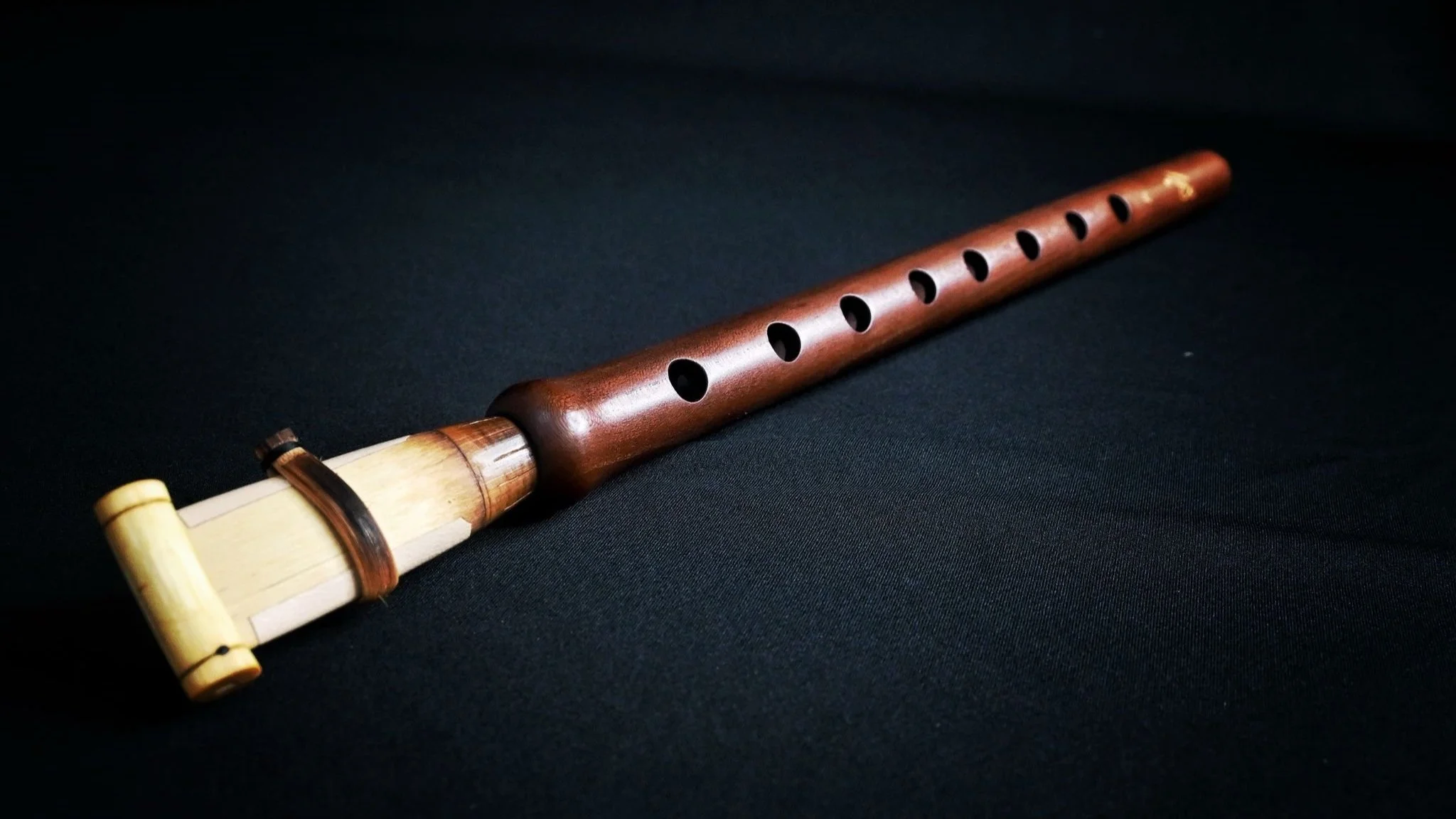
• The Duduk is a short, cylindrical flute, usually 28 to 40 cm (11 to 16 inches) in length, depending on its key.
• It is traditionally made from apricot wood, which is dense and resonant, providing the Duduk’s characteristic warm sound. Other woods, like plum or walnut, can be used, but apricot wood remains the most authentic and preferred material.
• The reed (ghamish) is large, wide, and flat, giving the Duduk its distinct timbre. It is made from cane and carefully hand-crafted to achieve the right resistance and vibration.
• Unlike other double-reed instruments like the oboe, the Duduk’s reed is much wider and softer, producing a full, velvety tone rather than a piercing sound.
• The instrument has 7 finger holes on the front and 1 thumb hole on the back, allowing for a variety of notes and microtonal adjustments.
Why is the Duduk Unique?
1. Emotional Depth – The Duduk is often called “the voice of Armenia” because of its ability to express deep sorrow and longing.
2. Warm, Breath-Like Tone – Unlike sharper woodwinds, the Duduk produces a soft, human-like quality, making it feel personal and intimate.
3. Cultural Heritage – With over a millennium of history, it connects players to Armenian traditions and ancient musical expressions.
4. Drone Accompaniment – The traditional continuous drone note played alongside the melody adds a mystical and immersive quality.
The Armenian Duduk is a profoundly expressive instrument that captures the soul of Armenian music. Its ancient history, warm and emotional sound, and unique construction make it a must-have for world music enthusiasts, film composers, and musicians looking to explore deep, resonant, and evocative tones. Whether played solo or accompanied by a drone, the Duduk has a timeless, almost spiritual quality that continues to captivate audiences worldwide.
A Deeply Soulful Wind Instrument Handcrafted by Gerardo Hernandez
History and Cultural Significance
The Duduk is an ancient double-reed woodwind instrument that originates from Armenia, dating back to 1200 BC, though some scholars believe its roots could be even older. It has been an integral part of Armenian music, often used in folk songs, spiritual music, and even contemporary compositions. The UNESCO recognized the Duduk and its music as an Intangible Cultural Heritage of Humanity in 2005, emphasizing its importance to Armenian culture.
The Duduk is traditionally played in both joyful and sorrowful settings, often used at weddings, funerals, and celebrations to evoke deep emotion. It is also widely recognized in film scores, with its haunting tones featured in movies like Gladiator (2000) “The Lion, The Witch and The Wardrobe” and “Game of Thrones” as Daenerys’ theme song and The Last Temptation of Christ (1988), bringing Armenian musical heritage to global audiences.
Tone and Sound
The sound of the Duduk is warm, deep, and expressive, often described as mournful and meditative. Unlike the sharp and bright tones of some woodwinds, the Duduk has a soft, breathy timbre that closely resembles the human voice, making it ideal for deeply emotional melodies.
• The tuning is typically in A, Bb, C, D, E, or G, with A being the most common.
• The range is around one octave and a third, though skilled players can extend this through advanced techniques.
• The Duduk is often played in pairs: one musician plays the melody, while another plays a continuous drone note to create a harmonic foundation. This drone creates a rich, textured atmosphere unique to Armenian music.
• It is a chromatic instrument, meaning that through half-hole fingering and embouchure control, it can produce all the notes within its range.
Physical Appearance and Construction
• The Duduk is a short, cylindrical flute, usually 28 to 40 cm (11 to 16 inches) in length, depending on its key.
• It is traditionally made from apricot wood, which is dense and resonant, providing the Duduk’s characteristic warm sound. Other woods, like plum or walnut, can be used, but apricot wood remains the most authentic and preferred material.
• The reed (ghamish) is large, wide, and flat, giving the Duduk its distinct timbre. It is made from cane and carefully hand-crafted to achieve the right resistance and vibration.
• Unlike other double-reed instruments like the oboe, the Duduk’s reed is much wider and softer, producing a full, velvety tone rather than a piercing sound.
• The instrument has 7 finger holes on the front and 1 thumb hole on the back, allowing for a variety of notes and microtonal adjustments.
Why is the Duduk Unique?
1. Emotional Depth – The Duduk is often called “the voice of Armenia” because of its ability to express deep sorrow and longing.
2. Warm, Breath-Like Tone – Unlike sharper woodwinds, the Duduk produces a soft, human-like quality, making it feel personal and intimate.
3. Cultural Heritage – With over a millennium of history, it connects players to Armenian traditions and ancient musical expressions.
4. Drone Accompaniment – The traditional continuous drone note played alongside the melody adds a mystical and immersive quality.
The Armenian Duduk is a profoundly expressive instrument that captures the soul of Armenian music. Its ancient history, warm and emotional sound, and unique construction make it a must-have for world music enthusiasts, film composers, and musicians looking to explore deep, resonant, and evocative tones. Whether played solo or accompanied by a drone, the Duduk has a timeless, almost spiritual quality that continues to captivate audiences worldwide.